Thursday, February 9, 2017

Inventor of The Surya Namaskara

Pranayama is the ability to control one’s breath so that the inhalation and exhalation of air is rhythmic. Vayu, the god of air ans wind, first taught pranayama to his son Hanuman, who in turn taught it to mankind.

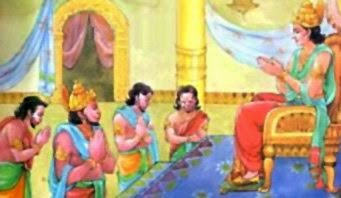
The Surya Namaskara (salutation to the sun) too, was devised by Hanuman as a greeting to his teacher Surya (Sun God).

Hanuman and Sun God

A next possible origin of the dynamic sequence of the sun could lie in the Ramanaya, one of the great epics of India.  As they see the vast ocean, they are grieved over the inability to cross this body of water. Then Hanuman recalls his powers; enlarging his body, he takes a leap and consequently flies across the ocean.

The story goes that Hanuman makes some kind of prologue before he leaps. This possible line of interpretation could be elaborated upon by linking the leap to Lanka with the leap back; from Lanka to the southern shores of India. In this leap back Hanuman’s tail is set on fire by Ravanas’ army. Hanuman's stay on Lanka could be viewed as a form of tapas (austerity). Hanuman extinguishes the fire by putting his tail in the sea. Linking the fiery practice of burning karma to the resulting coolness of true peace.

Today Surya Namaskar is practiced in many variations. Traditionally mantras accompany each of the 12 positions, with each mantra honouring the 12 zodiac signs in Hindu astrology and the 12 sound syllables containing the Shakti (energy) represented by the sun. Below is an image of the positions as well as the mantras. Perhaps this June 21st, the Summer Solstice, take some time to slowly move through each of the poses repeating the mantra and visualizing the sun shining its eternal light upon you. Even better, practice outside. A beautiful way to pay homage to the life force of the sun and to feel its Shakti energy within you.

What is surya Namaskara?

Without the Sun, there will be no life on Earth. Surya Namaskar or Sun Salutation is a very ancient technique of paying respect or expressing gratitude to the Sun that is the source of all forms of life on the planet. Now just knowing how to do Surya Namaskar is not enough. It is also important to understand the science behind this very ancient technique, because a deeper understanding will bring forth the right outlook and approach towards this very sacred and powerful yogic technique.

1.    OM mitraya namaha ~ Salutations to the friend of all
2.    OM ravaye namaha ~ Salutations to the shining one
3.    OM suryaya namaha ~ Salutations to he who induces activity
4.    OM bhanave namaha ~ Salutations to he who illuminates
5.    OM khagaya namaha ~ Salutations to he who moves through the sky
6.    OM pushne namaha ~ Salutations to the giver of strength and nourishment
7.    OM hiranyagarbhaya namaha ~ Salutations to the golden cosmic self
8.    OM marichaye namaha ~ Salutations to the rays of the sun
9.    OM adityaya namaha ~ Salutations to the son of Aditi (the cosmic mother)
10.  OM savitre namaha ~ Salutations to the stimulating power of the sun
11.  OM arkaya namaha ~ Salutations to he who is fit to be praised
12.  OM bhaskaraya namaha ~ Salutations to he who leads to enlightenment
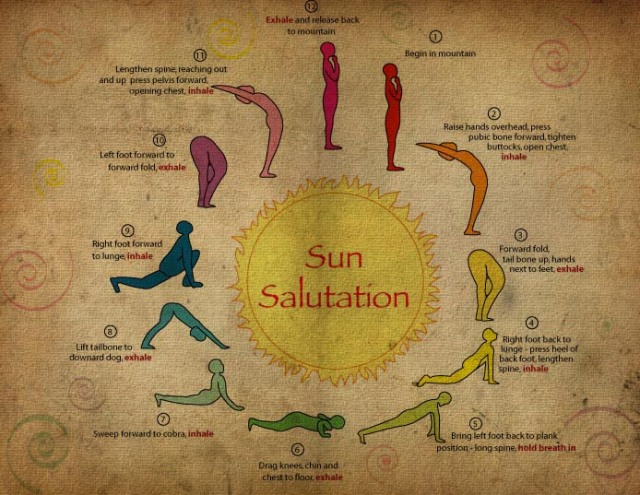
Image result for traditional sun salutation
Sun Salutation

The science behind Surya Namaskara:

It has been said (by the ancient Rishis of India) that the different parts of the body are governed by different Devas (divine impulses or divine light). The solar plexus (located behind the navel, which is the central point of the human body) is said to be connected with the Sun. This is the main reason why the ancient Rishis recommended the practice of Surya Namaskar, because the regular practice of this technique enhances the solar plexus, which increases one's creativity and intuitive abilities.
All our emotions get stored in the solar plexus, and it is also the point from where one's gut feelings arise. The size of the solar plexus is said to like the size of a small gooseberry. However, for those who do yoga and meditation, it becomes much bigger - almost three to four times bigger than the normal size. The more expanded your solar plexus, the greater is your mental stability and your intuition.

The body (through the physical movement), the mind (though the solar plexus) and the spirit (through the chants) get a boost from the practice of Surya Namaskar.

Surya Namaskara Steps


Benefits of Surya Namaskara:

The muscles are strengthened and become well-toned (Steps 1-12).

Blood circulation is improved and irregular menstrual cycles are regulated (Steps 3, 5, 7).
Surya namaskar is effective in reducing the weight of individuals. Abdominal muscles get well-toned and excessive fat around the waist is lost. Extra calories are lost and flexibility is improved. Digestion is improved (Steps 3 & 7).

Depression is alleviated and anxiety is reduced (Step 5).

Sleep and concentration are improved (Step 1).
Functioning of the endocrine system, including thyroid, pituitary glands, adrenal gland, parathyroid, testes, and ovaries are improved (Step 4).

Maintains good posture (Steps 2, 4)

Lord Hanuman invented Surya Namaskara as greeting to
Surya (Sun God)


Jai Sri Ram


Wednesday, November 23, 2016

Five Faced Hanuman Temple in Rameshwaram

Rameshwaram, as a temple town and one of the post important pilgrim centres in India, is pretty famous for its temples and religious sites. From the world famous Ramanathaswamy Temple to lesser known temples like Gandamadana, it has many attraction for Hindu pilgrims. The Five faced Hanuman Temple (or Panchmukhi Hanuman Temple) is another relatively lesser known but a unique destination for Hindu pilgrims, specially Hanuman bhakts.

 The Story of The Five Faced Hanuman Temple in Rameshwaram
Panchamukhi Hanuman

The Five Faced Hanuman Temple is located at a distance of about 2 km from Rameshwaram Temple and has an idol of Hanuman fully covered in Senthooram (vermillion. In 1964 after the cyclone of Danushkodi, idols of Lord Rama and Goddess Sita were brought from Dhanushkodi and placed in this temple. It is believed that the floating stone used for making the bridge across the sea to Lanka (Sri Lanka) is the same stone that is kept outside this temple floating in a water tank. These stones are oval in shape and have coarse texture with small craters.

The origin of the Five Faced (or panchmukhi) Hanuman can be traced to a story in Ramanayana. When Lord Rama was engaged in the final war with Ravana, Ravana asked Ahiravana, the king of Patala, to take Rama and Lakshmana to Patala Lok. Ahiravana, in the disguise of Vibhishana, the noble brother of Ravana, took Rama and Lakshmana to Patala to kill them.

When Hanuman got to know about this he entered Patala in search of Rama and his brother. There he discovered that the life of Ahiravana was hidden in five lamps which were placed in different directions and Ahiravana could only be killed by extinguishing these five lamps at the same time. To accomplish this, Hanuman took the form of Panchamukha Hanuman and blew out the five lamps in five directions. Along with Hanuman, the other four faces are Hayagriva, Narasimha, Garuda and Varaha.

It is this Five Faced Hanuman idol that is kept in the temple at Rameshwaram.
  
The five faces of Hanuman also signify the five senses (panch indriyas) over which Hanuman has mastery, as he was a great yogi. They also represent the five elements (wind, water, earth, fire and sky) which are the basis of creation.

Refer the Article Panchamukha Hanuman for more details.

Jai Sri Ram

Wednesday, July 2, 2014

Hanuman in Mahabharata


We are all familiar with Hanuman's extremely important role in Ramayana. But only a few of us know that Lord Hanuman also appears in the epic Mahabharata, twice.


It is a well-known fact that Lord Hanuman is one of the 'Chiranjeevis'. Chiranjeevis are the people who are supposed to be immortals. Hanuman, being one of the Chiranjeevis has been granted with the boon to live forever. So, we find Lord Hanuman being mentioned in Mahabharata.

Lord Hanuman is also considered the brother of Bhima as they have the same father, Vayu. Therefore the first mention of Lord Hanuman in Mahabharata comes when He meets Bhima during the Pandavas exile and the second time when Lord Hanuman protected the chariot of Arjuna throughout the battle of Kurukshetra by residing in Arjuna's flag.

Bhima's Encounter With Hanuman

When the Pandavas were in exile, once Draupadi asked Bhima to get the Saugandhika flowers for her. Bhima set out in search for the flowers. On his way, Bhima came across a huge monkey lying on the way, taking rest. Irritated by this, Bhima asked the monkey to clear the path and let him pass. But the monkey requested him that he is very old and cannot move on his own. So, if Bhima wishes to pass, then he must push the tail aside and move ahead.


Bhima was filled with contempt for the monkey and tried to push the tail with his mace. But the tail would not even move an inch. After trying hard for long, Bhima realised this was no ordinary monkey. So, Bhima gave up and asked for pardon. Thus, Lord Hanuman came in His original form and blessed Bhima.

Arjuna's Chariot

In another incident in the Mahabharata, Hanuman met Arjuna in the form of a normal monkey in Rameshwaram. On seeing the bridge built to Lanka by Lord Ram, Arjuna expressed his wonder as to why Lord Ram needed the help of monkeys to build the bridge. If it were him, he would have built the bridge himself with arrows. Hanuman, in the form of monkey criticised Arjuna that the bridge built with arrows would not suffice and will not bear the weight of even one person. Arjuna took it as a challenge. Arjuna vowed that if the bridge built by him did not suffice, then he will jump into fire. So, Arjuna built a bridge with his arrows. As Hanuman stepped on it, the bridge collapsed. Arjuna was dumbfounded and decided to end his life.


Just then Lord Krishna appeared in front of them and with His divine touch, re-built the bridge. The He asked Hanuman to step on it. This time the bridge did not break. Thus, Hanuman came in His original form and promised to help Arjuna in the war. Therefore, when the war of Kurukshetra commenced, Lord Hanuman perched on the flag of the chariot of Arjuna and stayed till the end of the war.


On the last day of the Kurukshetra war, Lord Krishna asked Arjuna to step out of the chariot first. After Arjuna stepped out, Lord Krishna thanked Hanuman for being there till the end. So, Lord Hanuman bowed and left the chariot. As soon as Hanuman left, the chariot caught fire. Arjuna was amazed to see this. Then Lord Krishna explained to Arjuna that the chariot would have been burnt long ago if Lord Hanuman was not protecting it against the celestial weapons.

Jai Sri Ram

Tuesday, July 1, 2014

Hanuman's Education


Hanuman selected Surya, the sun god as his preceptor, and approached him with the request to teach the scriptures.


Surya agreed and Hanuman became his disciple, but had to face his constantly moving guru by traversing the sky backwards at equal pace, while taking his lessons.


Hanuman's phenomenal concentration took him only 60 hours to master the scriptures.
Surya considered the manner in which Hanuman accomplished his studies as his tuition fees, but when Hanuman requested him to accept something more than that, the sun god asked Hanuman to assist his son Sugriva, by being his minister and compatriot.


 Jai Sri Ram