Showing posts with label Hanuman Stories. Show all posts

Tuesday, April 7, 2020

Hanuman in search of Rama's Ring

When Ram Rajya was established, everything was going right then all devtas felt that it is time for Lord Vishnu to return back to his abode.

They approached Yamraja. Yamaraja tried many times but was not able to reach Ram and take away his life because Hanuman guarded Ram’s life.

Rama understood the problem Yamaraja was facing and decided to trick Hanuman.


Ram dropped his ring. The ring fell into a crack in the floor. Ram then asked Hanuman to go and fetch the ring.

Hanuman could change his large body into as small as a fly. So he jumped into crack. He followed the crack until he reached patal-loka.

When he reached patal-loka he was greated by king of snakes. The king of snakes knew the secret of life and death.

He asked Hanuman what was he looking for?

Hanuman replied, I am hanuman and I am looking for Ram’s ring.

He said, come with me I will give you ring. He took Hanuman to a room full of Ram’s rings. And asked him to take anyone.

Hanuman was surprised and asked him how can there be so many rings?

He replied each ring represent one kal chakra. In every chakra, there is a treta-yuga in which there is a Ram and a Hanuman.

Every time Ram will drop his ring and a monkey will come to patal loka searching for his ring. By the time monkey returns back to earth Ram is gone.

Hanuman then understands the kal-chakra and he let go his dear God Rama!

Source : Bhagavatam kata

                                Jai Sri Ram

Wednesday, July 2, 2014

Hanuman in Mahabharata


We are all familiar with Hanuman's extremely important role in Ramayana. But only a few of us know that Lord Hanuman also appears in the epic Mahabharata, twice.


It is a well-known fact that Lord Hanuman is one of the 'Chiranjeevis'. Chiranjeevis are the people who are supposed to be immortals. Hanuman, being one of the Chiranjeevis has been granted with the boon to live forever. So, we find Lord Hanuman being mentioned in Mahabharata.

Lord Hanuman is also considered the brother of Bhima as they have the same father, Vayu. Therefore the first mention of Lord Hanuman in Mahabharata comes when He meets Bhima during the Pandavas exile and the second time when Lord Hanuman protected the chariot of Arjuna throughout the battle of Kurukshetra by residing in Arjuna's flag.

Bhima's Encounter With Hanuman

When the Pandavas were in exile, once Draupadi asked Bhima to get the Saugandhika flowers for her. Bhima set out in search for the flowers. On his way, Bhima came across a huge monkey lying on the way, taking rest. Irritated by this, Bhima asked the monkey to clear the path and let him pass. But the monkey requested him that he is very old and cannot move on his own. So, if Bhima wishes to pass, then he must push the tail aside and move ahead.


Bhima was filled with contempt for the monkey and tried to push the tail with his mace. But the tail would not even move an inch. After trying hard for long, Bhima realised this was no ordinary monkey. So, Bhima gave up and asked for pardon. Thus, Lord Hanuman came in His original form and blessed Bhima.

Arjuna's Chariot

In another incident in the Mahabharata, Hanuman met Arjuna in the form of a normal monkey in Rameshwaram. On seeing the bridge built to Lanka by Lord Ram, Arjuna expressed his wonder as to why Lord Ram needed the help of monkeys to build the bridge. If it were him, he would have built the bridge himself with arrows. Hanuman, in the form of monkey criticised Arjuna that the bridge built with arrows would not suffice and will not bear the weight of even one person. Arjuna took it as a challenge. Arjuna vowed that if the bridge built by him did not suffice, then he will jump into fire. So, Arjuna built a bridge with his arrows. As Hanuman stepped on it, the bridge collapsed. Arjuna was dumbfounded and decided to end his life.


Just then Lord Krishna appeared in front of them and with His divine touch, re-built the bridge. The He asked Hanuman to step on it. This time the bridge did not break. Thus, Hanuman came in His original form and promised to help Arjuna in the war. Therefore, when the war of Kurukshetra commenced, Lord Hanuman perched on the flag of the chariot of Arjuna and stayed till the end of the war.


On the last day of the Kurukshetra war, Lord Krishna asked Arjuna to step out of the chariot first. After Arjuna stepped out, Lord Krishna thanked Hanuman for being there till the end. So, Lord Hanuman bowed and left the chariot. As soon as Hanuman left, the chariot caught fire. Arjuna was amazed to see this. Then Lord Krishna explained to Arjuna that the chariot would have been burnt long ago if Lord Hanuman was not protecting it against the celestial weapons.

Jai Sri Ram

Tuesday, July 1, 2014

Hanuman's Education


Hanuman selected Surya, the sun god as his preceptor, and approached him with the request to teach the scriptures.


Surya agreed and Hanuman became his disciple, but had to face his constantly moving guru by traversing the sky backwards at equal pace, while taking his lessons.


Hanuman's phenomenal concentration took him only 60 hours to master the scriptures.
Surya considered the manner in which Hanuman accomplished his studies as his tuition fees, but when Hanuman requested him to accept something more than that, the sun god asked Hanuman to assist his son Sugriva, by being his minister and compatriot.


 Jai Sri Ram

Wednesday, August 14, 2013

Lord Hanuman meeting Kaalnemi Raakshas

When Lakshmana was hurt in the war, Hanuman was on his way to the Himalayas to bring the sanjeevani Buti. 


In the meantime a spy informed Raavan about this. Raavan immediately sent one Kaalnemi named Raakshas to stop him bringing those herbs. Kaalnemi said to Raavan - "Who has burned your whole Lankaa, who can stop him from doing Lord Ram's work? Meditate upon He who controls Kaal. Who can win Him?" But Raavan didn't like his advice. So Kaalnemi thought it was better to die from Raam's messenger's hand instead of this Raakshas. 

Kaalnemi raakshas in the form of a muni (sage)


So he went and built a beautiful Maayaa Aashram and a pond in it, and he himself stayed there in the form of a Muni. Flying over that Aashram Hanumaan saw it, so he thought, "let me drink some cool water here and take rest then I will proceed further", so he got down and went to Muni and asked some water. Muni gave him some water from his Kamandal, but Hanumaan was not satisfied with such a small amount of water, so Kaalnemi pointed towards the pond for more water. 

Lord Hanuman meeting Kaalnemi raakshas


Hanumaan entered the pond, that a she-crocodile caught his feet. Hanumaan killed her. She changed into an Apsaraa. She said - "My all sins are washed away today after having your Darshan and my Shaap (curse) is also cleared. 

Hanuman drinking water in the pond


She-Crocodile turns in to an Apsara


Listen, this is not a Muni but is a Raakshas, believe Me." and went away. Hanumaan came back and killed that Raakshas and headed towards his destination.

Hanuman Kills Kaalnemi 


Jai Sri Ram


Tuesday, August 6, 2013

Lord Hanuman and Shani dev

There is a popular belief that worshiping Lord Hanuman will help in removing the hardships caused by Lord Shani or Saturn in astrology. People worship Lord Hanuman on Saturdays to remove the malefic influence of Lord Shani on their horoscope. There is an interesting story regarding why worshipping Hanuman will help in Shani Dosha or Sade Sati. 


Ravan, the demon-king Ramayana, had defeated all the Devas and had brought all the grahas (planets in astrology) under control. Ravana kept all the grahas (planets) suppressed beneath his leg. Ravana was also a great astrologer. When his eldest son, Indrajit, was about to be born he forcefully kept all the grahas in the most favorable astrological position. 

The Demigods (Devas) were worried that if Ravana’s son was born in a favourable astrological position, he will be undefeatable. So the Devas asked all the grahas (planets) to move from the favourable position. But they told they were unable to escape from the foot of Ravana. Shani graham or Saturn agreed to help provided he was able to glance upon Ravana’s face. 

There is a popular belief that Shani Drishti, or Shani’s glance, is as deadly as his position. Shani is believed to cast an evil eye and this causes deep trouble. 

The Devas took the help of Saint Narada to achieve Shani Drishti. Saint Narada reached the palace of Ravana and saw Shani and other planets under the feet of Ravana. Saint Narada praised Ravana’s victory over the grahas and said that he should stamp on their chest and this is true symbol of victory and not on their back as he is doing now. 

Ravana agreed to Narada’s observation and immediately got the planets turned up. As Shani turned up, his glance fell on Ravana’s face and this kick-started his hardships. 

To take revenge on Shani, Ravana kept him in a tiny prison that had no opening so that no one will again see Shani’s face. But Ravana knew that Shani was not a child which could be imprisoned in a small cage. So what he did was tied up shani above a Shiv linga in such a way that if he tried of escape he would had have to step on it. Shani being a devotee and student to Lord Shiva did not do that. 

Hanuman wanted to know what sufferings he will have to face. Shani explained that first I will come upon on your head and this will make you leave your home, wife and sons and go about suffering. 

Hanuman said that Shani can definitely come upon his head as he has no family and his abode is at the feet of Lord Ram. 

Shani took refuge on Hanuman’s head. Hanuman then began to fight the demons that chased him in Lanka. In the process Hanuman began to head heavy boulders, trees and rocks. He crushed huge rocks with his head and Shani was getting hurt and suffering in the process. 

Finally, Shani got away from Hanuman’s head and said that you are the only one who will have no effect of inauspiciousness. I cannot trouble you. Since you have saved me from Ravana’s prison I would like to give you a boon. 

As the boon, Hanuman asked Lord Shani not trouble or cast evil eye on his devotees. Lord Shani promised not to trouble or cause hardships to Hanuman devotees.


Jai Sri Ram

Friday, July 26, 2013

Hanuman meets Lord Rama

When Hanuman grew up he became the minister of Sugreeva, the King of Kishkindha. Vali was the elder brother of Sugreeva. Once Vali, who was fighting with a rakshasa, entered a cave with his opponent; he did not come out for a long time. Blood began to flow from the cave, so Sugreeva thought that Vali was dead. He returned to Kishkindha and became its king. But a little later, Vali returned and drove out Sugreeva. Sugreeva and his ministers hid themselves in the Malaya mountains; Vali could not enter this region. 


When Shri Rama, his wife Sita and his brother Lakshmana were in the forest, a rakshasa by name Ravana took away Sita by force. Rama was in great grief. He was wandering in the forests and came to Kishkindha. Sugreeva saw him when he came with Lakshmana to the Malaya mountains. Sugreeva and his companions were full of fear that Vali had sent Shri Rama and Lakshmana to kill them. But Hanuman asked them not to be afraid. Sugreeva was also very anxious to know who those handsome young men were. Whom should he send to talk to them? Finally he choose Hanuman. 

Hanuman was an excellent ambassador. He could easily understand the nature of other people. As soon as he saw Rama and Lakshmana, he realized that they were not deceivers, but noble persons. In soft and pleasing words he asked them who they were, and told them about him. Rama was very happy when he heard the words of Hanuman. He said to Lakshmana, "Did you hear his words? Even an enemy with his sword drawn would be pacified by such words. If a ruler has such a messenger, his efforts will always be successful." 


Hanuman took Rama and Lakshmana to Sugreeva. He had hopes that these brave young men would make Sugreeva king again. 

Sugreeva's Minister, Rama's Messenger 

Rama and Sugreeva became friends very soon. When Sugreeva challenged Vali to a fight, Rama helped his friend by killing Vali with an arrow. 


When she heard this sad news, Vali's wife, Thara was full of grief. She fell on his body, weeping. Hanuman prostrated before her and said, "Revered lady, Vali came to this condition because of his evil deeds, his own actions. Sugreeva was only the means. Please do not think that Sugreeva killed Vali. No one can live for all times in this world. Look at your son Angada and console yourself." 

Sugreeva then became king. All his troubles were over. The kingdom was his. He forgot his promise to Rama that he would immediately send servants to search for Sita and find her. He left the responsibilities of the state to his ministers; he forgot everything in his pleasures. 

Hanuman warned him. He did his duty as a minister, saying the right thing at the right time. He said to Sugreeva, "O King, the kingdom and the fame which you desired are now yours. If you do not help your friends at the right time, even the greatest help you offer later will be totally useless. Though Rama is very anxious to find Sita, he is waiting for you. It is already late, but he is a patient man. Please send your army at once to search for Sita." 

Sugreeva sent Neela, one of his commanders, to find out where Sita was. And he returned to his pleasures.

The rainy season was over. It was now autumn. Rama's mind was always filled with thoughts of Sita's sufferings and sorrows, and he was miserable. He revealed his misery to Lakshmana. Hot blooded Lakshmana was very angry with Sugreeva. He went to see Sugreeva. His anger made Sugreeva's subjects shiver with fear. Sugreeva himself was so terrified; he did not know what to do. 


Again it was Hanuman who gave wise counsel. He said to Sugreeva, "Shri Rama may not really be angry with you. Perhaps he was sent Lakshmana to you as his work has been delayed. When those who are more powerful than we are enraged, it is not wise for us to become angry. Our anger will only heighten their rage. At such times we should seek to pacify the mighty. Besides, Shri Rama has helped you and therefore you should behave respectfully towards him." 


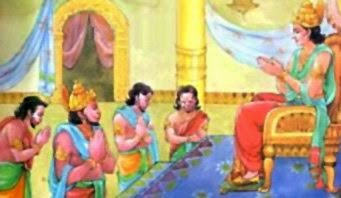
This time advice was effective. Sugreeva pacified Lakshmana, and with his entire army went to Rama. He sent the army in all the four directions to find out where Sita was. Vast as the ocean, the army set off with shouts of enthusiasm. The deafening noise seemed to make the earth Shiver. Shri Rama removed a ring from his finger and giving it to Hanuman, said: "When Sita sees you, she may be afraid of you, or may not believe your words. If that happens, show her this ring. We depend entirely on your strength." 


Hanuman prostrated before Rama and set off.

Hanuman meets Sita Ji


Jai Sri Ram

Monday, July 15, 2013

Hanuman meets Sita Ji (Sundara Kanda)

The Sundara Kanda forms the heart of Valmiki's Ramayana and consists of a detailed, vivid account of Hanuman's adventures. After learning about Sita, Hanuman assumes a gargantuan form and makes a colossal leap across the ocean to Lanka. 


To cross the ocean, Lord Hanuman takes on the size of a mountain. Hanuman soared skyward. He shone like the sun. He crossed the surging sea in a single bound. 

In no time at all he reached the distant shore of Lanka. At first he could not find Sita. He looked everywhere-in Lanka’s streets, in all the houses, even in the royal harem. Finally he went beyond the city to the gardens and orchards of the royal estate. There in the centre of a grove known as the Ashok Vatika he found the captive princess seated in the shade of a giant tree. 


She was very pale. Like the waning moon, she had become quite slim. The grief of separation from her beloved Rama had not, however, dimmed her radiance. She glowed by virtue of her inner purity. Like the moon, too, she remained always luminous and lovely. 

Even while he watched from a hiding place not far from her, Hanuman saw the cruel king, Ravana, make his regular visit to Sita in her seclusion. "For ten months you have remained here mooning over Rama. You have but two months left to forget him and show favour to me. I warn you, relent or my cooks will make mince—meat pie out of you for me to eat." Sita remained brave all the while that Ravana was there, but when he left she broke into tears. 


While she wept, Hanuman crept nearer to her. Gently he murmured that he was a messenger. "Rama sent me." Sita lifted her eyes in disbelief, and Hanuman caught his breath at the sight of her fragile beauty. He gave her Rama’s ring to show that he spoke the truth. He promised her that Rama would come for her. In turn, she removed the jewel which still adorned her hair. "Give this to Rama. Tell him to come f or me, or I shall die." 


Hanuman left her with comforting words, then went back to the streets of the capital determined to do mischief to the rakshasas and to see Ravana face to face before leaving Lanka. With this in mind, he got into fights with rakshasa soldiers. After scuffling with several he decided to let them capture him. He knew that, as a prisoner, he would be taken before Ravana. Sure enough, he was soon hauled before the king, and there Hanuman heckled him. 


Furious at this insult, Ravana ordered Hanuman bound head and foot. "Set his tail on fire!" 

Hanuman smiled at this, for it was just what he wanted. Once his tail was flaming, he easily slipped out of his bonds and into the night. No one could catch him. Laughing at how helpless they all were against his wonders, Hanuman hopped from house to house until he had touched each with his tail, setting the entire city on fire. 


Satisfied that the rakshasas would remember him and his visit forever, he went to the seashore. In one mighty leap he crossed the ocean once more, and rejoined the group waiting for him on the other side. 


Hanuman informs Rama how Seetha expressed her grave doubt as to how monkeys and bears can leap across a vast sea, as well as her appeal to Rama to destroy Ravana along with his entire army in Lanka and take her back to Ayodhya. Hanuma further informs Rama, how he resolved her doubt by explaining the prowess of the troops of monkeys and bears, commanded by Sugreeva as also how he brought solace and peace to her from her worries. 


Why Sundara Kanda is Important? 

It is traditional to begin the reading (pārāyaṇa) of the Ramayana with the Sundara Kanda. 

This lesson is recited, preferably on Tuesdays or Saturdays, these days having been earmarked for special prayers to Hanuman. It happens to be for nullification of the malefic effects of the crow mounted, the son of Surya and Chhaya (Shadow), Lord Shani. Ramayana reveals that Shani Dev, who was captive at Ravana's palace, was rescued by Lord Hanuman. As a token of thanks, Shani Dev offered reprieve to all devotees of Lord Hanuman. Alternately once Shani Dev was caught between Hanuman's shoulders and the ceiling when attempting to mount the latter to influence his stars. Unable to bear the pain, Shani Dev offered gratitude in return to an immediate release. 

The religious faith suggests that its recital brings harmony to the household. Many believe that if you do not have time to read the whole Ramayana, you should read the Sundara Kanda. 

Trails of Sundara Kanda in Srilanka : 

Sri Baktha Hanuman Temple,Ramboda :


Sri Baktha Hanuman Temple,Ramboda On these hills of Ramboda where Hanuman was searching for Setadevi, Chinmaya mission of Sri Lanka built a temple with Hanuman as the presiding deity. On every full moon day special pooja”s are conducted and witnessed by thousands of devotees. 

Mani Kattuther Rock Labookelle Estate :

This is a rock in the Labookelle estate. Lord Hanuman met Sitadevi and on his way to announce this happy information to Lord Rama, rested on this hill top. The hilltop where Lord Hanuman is believed to have rested after meeting Sitadevi is known as Mani Kattuther. Today an open temple with statues of Lord Rama, Sitadevi, Lakshmana and Lord hanuman stands on top of it . 

Ussangoda : 

According to Ramayana, after meeting Sitadevi Lord Hanuman dedicated to test the strength of the mighty King Ravana and his army of Rakshasas. In the events that unfolded Lord Hanuman's tail was set on fire by the rakshasa's, who in turn went on to torch some parts of King Ravana's empire. Ussangoda is one of the torched areas, which is said to have been a airport used by king Ravana 

Chariot Path and Sita Tear Pond :

The summit of the mountain next to the mountain range overlooking Frotoft Estate in Pussallawa is the place where Lord Hanuman first set his foot on mainland Lanka. This mountain known as Pawala Malai is visible from this mountain range. These hills stand tall in-between King Ravana's capital city and Ashoka Vatika. 

The barren land atop themountain range is believed to be the route in which King Ravana took Sitadevi from his capital city Lankapura to Ashoka Vatika, which was a paradise on earth. Till date no vegetation grows on this passage except grass. King Ravana is believed to have taken this passage on top of these hills to show Sitadevi the beauty of his kingdom. 


The Sita tear pond is found en route by the chariot route, is believed to have been formed by the tears of Sitadevi and has not dried up since, even during severe droughts when the adjoining rivers dry up. 


In this area there are many large trees whose bright red blooms add colour to the scenery. These flowers are called Sita flowers. The peculiarity of these flowers is the configuration of the petal's, stamen and pistil's, which resemble a human figure carrying a bow, and is said to represent Lord Rama. These flowers are unique only to this area in the whole of sri lanka.


Jai Sri Ram

Sunday, July 14, 2013

Hanuman Ji's favourite Vadas

Lord Hanuman loves the hard and crunchy vada so it is offered for the lord. 


According to legend, Hanuman was given a very big vada by His mother on the eve of His departure to Lanka for the war so that He could eat out of it little by little whenever He felt hungry. 

Another story goes that - In Ramayana on his return from Srilanka, following Lord Sri Rama’s victory over Ravana and the subsequent coronation of Lord Rama and Sita in Ayodhya, all the guests attending the coronation received gifts before their departure. But when it came to Sri Hanuman, Lord Sri Rama said that Hanuman would remain with him always. 

Overjoyed, Sita Devi made a Vadai Maalai for Hanuman and adorned it on him so that he would eat it and be happy. 


Since then, the practice of adorning Lord Hanuman with the Vadai Maalai came into existence.


Jai Sri Ram

Thursday, July 11, 2013

Hanuman's love for Lord Ram

After victory Lord Rama returns to Ayodhya and decides to ceremoniously reward all his well- wishers. 


Seeing Hanuman come up to him, an emotionally overwhelmed Rama embraces him warmly, declaring that he could never adequately honour or repay Hanuman for the help and services he received from him. 

Sita ji , however, insists that Hanuman deserved honor more than anyone else, and asks him to seek a gift. Upon Hanuman's request, Sita ji  gives him a necklace of precious stones adorning her neck. 


When he receives it, Hanuman immediately takes it apart, and peers into each stone. Taken aback, many of those present demands to know why he was destroying the precious gift. Hanuman answers that he was looking into the stones to make sure that Rama and Sita are in them, because if they are not, the necklace is of no value to him. 

At this, a few mock Hanuman, saying his reverence and love for Rama and Sita could not possibly be as deep as he was portraying. One of them asks Hanuman what about his own body, if that contains Lord Ram in it. 


In response, Hanuman tears his chest open, and everyone is stunned to see Rama and Sita literally in his heart. This shows the love and affection of Lord Hanuman towards Lord Ram-Sita ji.


Jai Sri Ram

Why we offer butter and betel leaves garland to Lord Hanuman?

Betel Leaves: 

After the success in the war against Ravana, Sita Devi spotted hanuman in a betel leaf garden when hanuman bowed to her feet seeking her blessings. Sita devi plucked few betel leaves and showered on hanuman in order to bless him, so the tradition is still followed. 

Another story goes that when Sri Hanuman conveyed the message from Sri Rama, Sita Devi garlanded Sri Hanuman with a betel vine as a token of Her joy and appreciation, as she could not find any flowers nearby. 


Betel leaves should be made into a garland with a piece of arecanut in each leaf. 


Butter: 

It was during the Rama Ravana war. Ravana was trying his best to defeat Rama. But each of his weapon was squashed by Rama's arrows. Rama was being carried by Hanuman as at that time. He did not have a war chariot like Ravana, whose ratha was magnificent. 

Ravana was becoming frustrated. Ravana changed his tactics. Instead of attacking Rama he started to shoot at Hanuman who was carrying Rama. Hanuman had got the boon of immortality from Brahma but that did not prevent him from getting injured. 

Lord Rama began to fight like a whirlwhind and soon made Ravana run from the battle field. Our Lord tolerates any amount of hardship but cannot see His bhaktas being troubled. When they retired to their camp Rama made Hanuman to lie down and inspite of his protests called for cool butter applied it Himself on Hanuman's burning wounds. So, the tradition is still followed.


Jai Sri Ram

Tuesday, July 9, 2013

Lord Hanuman with Aṇimā and Garima Siddhi


In the Ramayana Hanuman changes shape several times. For example, while he searches for the kidnapped Sita in Ravana's palaces on Lanka, he contracts himself to the size of a cat, so that he will not be detected by the enemy. Later on, he takes on the size of a mountain, blazing with radiance, to show his true power to Sita.

Also he enlarges & immediately afterwards contracts his body to out-wit Sirsa, the she-demon, who blocked his path while crossing the sea to reach Lanka. Again, he turns his body microscopically small to enter Lanka before killing Lankini, the she-demon guarding the gates of Lanka.

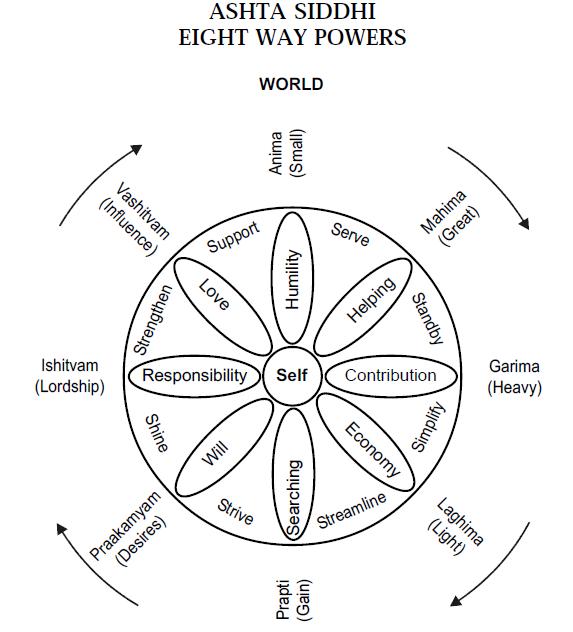
He achieved this shape-shifting by the powers of two siddhis; Anima and Garima bestowed upon him in his childhood by Sun-God, Surya.

Lord Hanuman with Anima and Garima Siddhi


• Aṇimā: reducing one's body even to the size of an atom
• Garima: becoming infinitely heavy

The following are the eight siddhis (asta-siddhis), 


• Anima 
• Laghima 
• Mahima 
• Garima 
• Prapti 
• Prakamya 
• Vashitva 
• Isitva 

These are basically to control to five elements, “paanch mahabhoot” (prithvi, jal, agni, vayu, akaash).

Footprints of Lord Hanuman : 

In Srilanka, a stream that runs from the hill, catered to the needs of Sita devi during her stay at Ashok Vatika. She is said to have bathed in this stream. Now there is a temple(Sita Amman temple/Sita Eliya) of Lord Rama, Sita devi , Laxmana and Hanuman by the side of this stream.


It is interesting to note that foot prints akin to Lord Hanuman's are found by this river and some are of small size and some are of large size, which tells us of the immense powers of Lord Hanuman transforming himself into any size.


Jai Sri Ram


Monday, July 8, 2013

Why Hanuman ji likes sindoor?

One day, Hanuman noticed that Sitaji wore a red powder in the parting of her hair. Curious, Hanuman enquired, what it was that she was wearing. Dear Hanuman, it is sindoor that I am wearing, said Sitaji. What is sindoor and why was it so important? asked Hanuman. Sindoor makes Lord Ram happy and would give Him a long and happy life, explain Sitaji. 

Hanuman thought for a long time. He realised that Sitaji also did it because she loved Ram and showed it by putting sindoor in her hair. I love Ramji too, though Hanuman, And Im going to prove it! So guess what He did? Well if Sita ji can put sindoor in her hair to show her love, He decided to cover Himself with it to show His love! He took the sindoor powder and smeared his whole body with it When He entered, He was completely red, His face, the nose, dhoti, everything was completely red. It looked as though He had taken a bath in the red powder! 

Sita looked at Him in surprise and asked Him why he had covered himself in sindoor. Hanuman said, Sitaji, you are a Devi, a goddess. By putting a little sindoor in your hair, you can make Lord Ram happy and His life longer. But I am only His servant, His dasa, so I will have to do more than that. And that is why I had to cover my whole body with sindoor. 

 This also shows the great love Hanuman had for Lord Rama. On hearing this , Lord Rama gave a boon to all his devotees that those who apply sindoor to Hanuman and observe hanuman pooja with sindoor would be blessed with longer and happy life.


Jai Sri Ram 

Hanuman brings Sanjeevani Buti

When Lakshmana is severely wounded during the battle against Ravana, Hanuman is sent to fetch the Sanjivani, a powerful life-restoring herb, from Dronagiri mountain, in the Himalayas, to revive him. Ravana realises that if Lakshmana dies, a distraught Rama would probably give up, and so he dispatches the sorcerer Kalanemi to intercept Hanuman. Kalanemi, in the guise of a sage, deceives Hanuman, but Hanuman uncovers his plot with the help of an apsara, whom he rescues from her accursed state as a crocodile.


 Lakshmana severely wounded in the battle


Ravana, upon learning that Kalanemi has been slain by Hanuman, summons Surya to rise before its appointed time because the physician Sushena had said that Lakshmana would perish if untreated by daybreak. Hanuman realizes the danger, however, and, becoming many times his normal size, detains the Sun God to prevent the break of day. He then resumes his search for the precious herb. 

So hanuman ji asked an old lady (who couldn't walk on her own) the address of DRONAGIRI PARVAT ,as hanunam ji saw only that old lady in the village because all the men were at their farmlands & doing all their agricultural activities there.

Hanuman ji climbing the parvat in search of sanjeevani


That old lady said that she knew the address of dronagiri parvat & she cud take hanuman ji there, hanuman ji made thta old lady sit on his shoulders & reached dronagiri paravat. But, when he finds himself unable to identify which herb it is, he lifts the entire dronagiri parvat. 

Hanuman ji carrying the dronagiri parvat with his left hand.


A coin depicting this scene


Sushena then identifies and administers the herb, and Lakshmana is saved. Rama embraces Hanuman, declaring him as dear to him as his own brother. Hanuman releases Surya from his grip, and asks forgiveness, as the Sun was also his Guru. 

Lakshmana back to life


 A deep insight: 

The portion which Hanuman dug out of the Himalayas or the dronagiri parvat was actually the right shoulder of dronagiri parvat !! & still the wounds of dronagiri parvat are alive!! it is said that dronagiri parvat is still feeling the pain of losing his right shoulder !! The residents of dronagiri parvat area still worship & pray to dronagiri so that dronagiri parvat's pain cud be less .
Dronagiri parvat is in uttaranchal state. People living in the village where dronagiri is situated feel themselves so lucky that they are residing under the shelter of an auspicious & holy mountain which saved the life of lakshman !!! Still when appearance wise dronagiri looks as if a big right portion of the mountain is missing. 

A part of dronagiri parvat in uttranchal


People say that still a monkey comes every year to dronagiri parvat & they all can see the arrival of monkey but no one has ever seen where monkey vanishes or goes after sometime ,it's very strange as monkeys r not at all found at the mountain area of DRONAGIRI & HIMALAYAN RANGE due to extremely cold conditions as monkeys don't like living in cold areas ,but it's strange that every year a monkey comes to dronagiri & disappears after sometime(as no one can see where that monkey goes away & what he does at dronagiri ) ,people of that village even followed that monkey but failed to know the secret. 

When hanuman ji brought the dronagiri parvat to srilanka, parts from the hill fell on five places in lanka, namely rumasala in galle, dolukanda in hiripitiya, ritigala, thalladi in mannar, and kachchativu in the north.

Dolukanda in hiripitiya 


Rumasala in galle


Sanjeevani Buti: 

Scientists investigating what they believe is the mythical Sanjeevani herb mentioned in the epic Ramayana have discovered that it can protect living cells from the lethal effects of heat and biological stress.

Laboratory experiments have indicated that unknown substances from a herb called Selaginella bryopteriscan promote cell growth and protect them from destructive biological injuries. 

Some researchers have speculated that Selaginella is Sanjeevani, used by Ram to revive his brother Lakshman injured in battle.

Sanjeevani buti 


Researchers from the Madhav Institute of Technology and Sciences, Gwalior, and the Centre for DNA Fingerprinting and Diagnostics, Hyderabad, examined the effect of the herb on insect cells and on cells taken from mice. 

To mimic the way the herb is used in traditional medicine, the scientists obtained the herbal extract by leaving the herb submerged overnight in an earthen pot. Then they added the extract to cells maintained in a chemical broth. “The extract protects the cells from the harmful effects of heat, ultraviolet rays and destructive chemicals called oxidants,” said Nand Sah, professor and head of biotechnology at the Madhav Institute. 

Ordinarily, living cells exposed to extreme heat, ultraviolet rays or oxidants such as hydrogen peroxide stop growing and, eventually, die. The studies on the cells carried out in Hyderabad have shown that adding the herbal extract into the mixture of cells can suppress cell death caused by ultraviolet radiation and oxidants as well as reverse heat-triggered growth arrest. 

National Botanical Research Institute (NBRI) is trying to identify the gene that helps Sanjivani Booti to survive severe droughts. The plant existed before 300 million years and comes under a group of plants which were the first vascular plants on earth. 

When there is no moisture the plant curls up and assumes the form of a brown crust. Sanjivani Booti regains its original form when it comes in contact with water or moisture. The plant grows in rocks and arid lands.

Research Paper on Sanjeevani : Check here


Jai Sri Ram