Lord Hanuman loves the hard and crunchy vada so it is offered for the lord.
According to legend, Hanuman was given a very big vada by His mother on the eve of His departure to Lanka for the war so that He could eat out of it little by little whenever He felt hungry.
Another story goes that - In Ramayana on his return from Srilanka, following Lord Sri Rama’s victory over Ravana and the subsequent coronation of Lord Rama and Sita in Ayodhya, all the guests attending the coronation received gifts before their departure. But when it came to Sri Hanuman, Lord Sri Rama said that Hanuman would remain with him always.
Overjoyed, Sita Devi made a Vadai Maalai for Hanuman and adorned it on him so that he would eat it and be happy.
Since then, the practice of adorning Lord Hanuman with the Vadai Maalai came into existence.
Jai Sri Ram
The origin of Sri Panchamukha Hanuman can be traced to a story in the Ramayana. During the war between Lord Ram and Ravana, Ravana took the help of Mahiravana who was the king of pathala.
Lord Hanuman in order to protect Lord Ram and Lakshman formed a fortress with his tail. But Mahiravana took the form of Vibeeshana and took Lord Ram and Lakshman to pathala loka.
Hanuman entered pathala loka in search of Rama and Lakshmana.He found out that to kill Mahiravana he had to extinguish 5 lamps at the same time. So he took the Panchamukha form with Hanuman, Hayagriva, Narasimha, Garuda and Varaha faces and extinguished the lamps. Mahiravana was killed immediately.
The Panchamukha form of Lord Hanuman has the following five faces:
• Hanuman (a fervent devotee of Lord Rama) – facing the east
• Narasimha ( an incarnation of Lord Vishnu, who slayed Hiranyakashipu) – facing the south
• Garuda ( the mount of Lord Krishna) – facing the west
• Varaha (an incarnation of Lord Vishnu, who slayed the demon Hiranyaksha) – facing the north
• Hayagriva (an incarnation of Lord Vishnu, considered the God of wisdom)– facing upwards
The details of panchamukha Hanuman are
• East facing Anjaneya to grant humanity Ishta Siddhi.
• South facing Karala Ugraveera Narasimha to grant humanity Abhista Siddhi.
• West facing Mahaveera Garuda to grant humanity Sakala Sowbhagya.
• North facing Lakshmi Varaha to grant humanity Dhana Prapthi.
• Urdhva Mukha(atop0 being Hayagriva to grant humanity Sarva Vidya Jaya Prapthi.
There are five ways of prayer to the Lord. They are Naman, Smaran, Keerthanam, Yachanam and Arpanam. The five faces depict these five forms. Lord Hanuman always used to Naman, Smaran and Keerthanam of Lord Sri Rama. He totally surrendered (Arpanam) to his Master Sri Ram. He also begged (yachanam) Sri Rama to bless him the undivided love.
Panchamukha Hanuman Stuthi:
The Panchamukha Hanuman Stuthi is a potent stotra meant to praise each of the five forms. This stotra helps to alleviate troubles and keep evil forces away. It serves as a protection to devotees who chant with utmost faith.
Om namo bhagavathe panchavadanaaya poorva kapi mukhe
Sakala shatru samhaarnaaya swaaha
The east facing form of Lord Hanuman protects devotees from problems caused by enemies. He provides happiness and fulfills wishes.
Om namo bhagavathe panchavadanaaya dakshina mukhe
Karaala vadanaaya Narasimhaaya sakala bhoota praeta pramadanaaya swaaha
The south facing form of Lord Narasimha removes all types of fear, sins, unfavorable influences of spirits and demons, and fulfills our wishes.
Om namo bhagavathe panchavadanaaya paschima mukhe
Garudaaya sakala visha haranaaya swaaha
The west facing form of Lord Garuda removes all types of ailments, negativities, black magic, poison, and fear.
Om namo bhagavathe panchavadanaaya uthara mukhe
Aadivarahaaya sakala sampatkaraaya swaaha
The north facing form of Lord Varaha provides the ashta aishwarya (eight different forms of wealth).
Om namo bhagavathe panchavadanaaya oordhwa mukhe
Hayagrivaaya sakala jana vasheekaranaaya swaaha
The upwards facing form of Lord Hayagriva helps devotees attract the goodwill of people. The words of His devotees turn into reality. He bestows them with advancement in seeking knowledge, good company of friends, intelligence, good children, and salvation.
The Panchamukha Hanuman Gayatri can be chanted to overcome obstacles in life.
Om Anjaneyaya Vidmahe Panchavaktraaya Dheemahi
Tanno Hanumath Prachodayaath
Jai Sri Ram
After victory Lord Rama returns to Ayodhya and decides to ceremoniously reward all his well- wishers.
Seeing Hanuman come up to him, an emotionally overwhelmed Rama embraces him warmly, declaring that he could never adequately honour or repay Hanuman for the help and services he received from him.
Sita ji , however, insists that Hanuman deserved honor more than anyone else, and asks him to seek a gift. Upon Hanuman's request, Sita ji gives him a necklace of precious stones adorning her neck.
When he receives it, Hanuman immediately takes it apart, and peers into each stone. Taken aback, many of those present demands to know why he was destroying the precious gift. Hanuman answers that he was looking into the stones to make sure that Rama and Sita are in them, because if they are not, the necklace is of no value to him.
At this, a few mock Hanuman, saying his reverence and love for Rama and Sita could not possibly be as deep as he was portraying.
One of them asks Hanuman what about his own body, if that contains Lord Ram in it.
In response, Hanuman tears his chest open, and everyone is stunned to see Rama and Sita literally in his heart. This shows the love and affection of Lord Hanuman towards Lord Ram-Sita ji.
Jai Sri Ram
Betel Leaves:
After the success in the war against Ravana, Sita Devi spotted hanuman in a betel leaf garden when hanuman bowed to her feet seeking her blessings. Sita devi plucked few betel leaves and showered on hanuman in order to bless him, so the tradition is still followed.
Another story goes that when Sri Hanuman conveyed the message from Sri Rama, Sita Devi garlanded Sri Hanuman with a betel vine as a token of Her joy and appreciation, as she could not find any flowers nearby.
Betel leaves should be made into a garland with a piece of arecanut in each leaf.
Butter:
It was during the Rama Ravana war. Ravana was trying his best to defeat Rama. But each of his weapon was squashed by Rama's arrows. Rama was being carried by Hanuman as at that time. He did not have a war chariot like Ravana, whose ratha was magnificent.
Ravana was becoming frustrated. Ravana changed his tactics. Instead of attacking Rama he started to shoot at Hanuman who was carrying Rama. Hanuman had got the boon of immortality from Brahma but that did not prevent him from getting injured.
Lord Rama began to fight like a whirlwhind and soon made Ravana run from the battle field. Our Lord tolerates any amount of hardship but cannot see His bhaktas being troubled. When they retired to their camp Rama made Hanuman to lie down and inspite of his protests called for cool butter applied it Himself on Hanuman's burning wounds. So, the tradition is still followed.
Jai Sri Ram
In the Ramayana Hanuman changes shape several times. For example, while he searches for the kidnapped Sita in Ravana's palaces on Lanka, he contracts himself to the size of a cat, so that he will not be detected by the enemy. Later on, he takes on the size of a mountain, blazing with radiance, to show his true power to Sita.
Also he enlarges & immediately afterwards contracts his body to out-wit Sirsa, the she-demon, who blocked his path while crossing the sea to reach Lanka. Again, he turns his body microscopically small to enter Lanka before killing Lankini, the she-demon guarding the gates of Lanka.
He achieved this shape-shifting by the powers of two siddhis; Anima and Garima bestowed upon him in his childhood by Sun-God, Surya.
Lord Hanuman with Anima and Garima Siddhi
• Aṇimā: reducing one's body even to the size of an atom
• Garima: becoming infinitely heavy
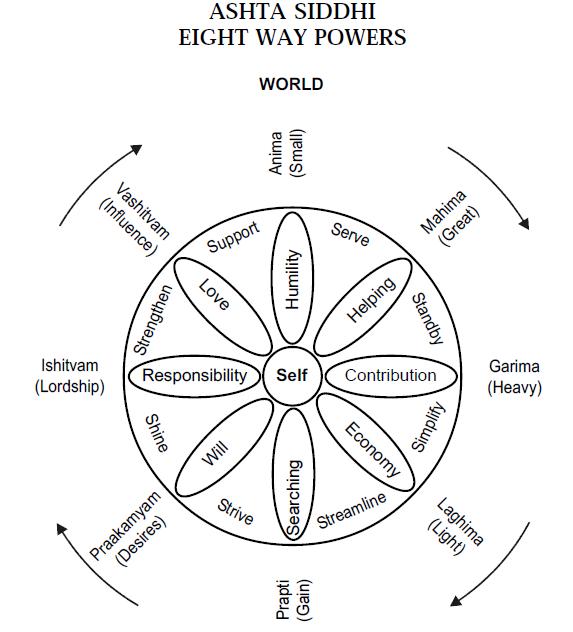
The following are the eight siddhis (asta-siddhis),
• Anima
• Laghima
• Mahima
• Garima
• Prapti
• Prakamya
• Vashitva
• Isitva
These are basically to control to five elements,
“paanch mahabhoot” (prithvi, jal, agni, vayu, akaash).
Footprints of Lord Hanuman :
In Srilanka, a stream that runs from the hill, catered to the needs of Sita devi during her stay at Ashok Vatika. She is said to have bathed in this stream. Now there is a temple(Sita Amman temple/Sita Eliya) of Lord Rama, Sita devi , Laxmana and Hanuman by the side of this stream.
It is interesting to note that foot prints akin to Lord Hanuman's are found by this river and some are of small size and some are of large size, which tells us of the immense powers of Lord Hanuman transforming himself into any size.
Jai Sri Ram